
Interblock Gaming aims to promote two roulette games from its AMUSE product line – “Free Fall Roulette” and “Dragon Roulette” – as well as its “Roll to Win Craps” machine for Asia’s gaming markets in the remainder of this year. The brand also pledges to enhance functions on its existing stadium gaming products, to reinforce its edge in the competitive electronic table game (ETG) segment.
That is according to Michael Hu, president of Asia-Pacific at Interblock, in an interview with GGRAsia at the Global Gaming Expo (G2E) Asia held recently at The Venetian Macao.
The AMUSE range and Roll to Win Craps were previewed to GGRAsia at last year’s G2E Asia @ the Philippines trade show and conference in Manila, the Philippine capital.
AMUSE has been described by the supplier as a “new sector” product range combining elements of ETG play, slot play and even live-table gaming, all packaged for an experience akin to an arcade game.
The AMUSE series has been “popular” in Las Vegas since going live on gaming floors in the Nevada, United States gaming hub, noted Mr Hu in his latest comments to GGRAsia, adding that boosted Interblock’s confidence in promoting it in Asia this year.
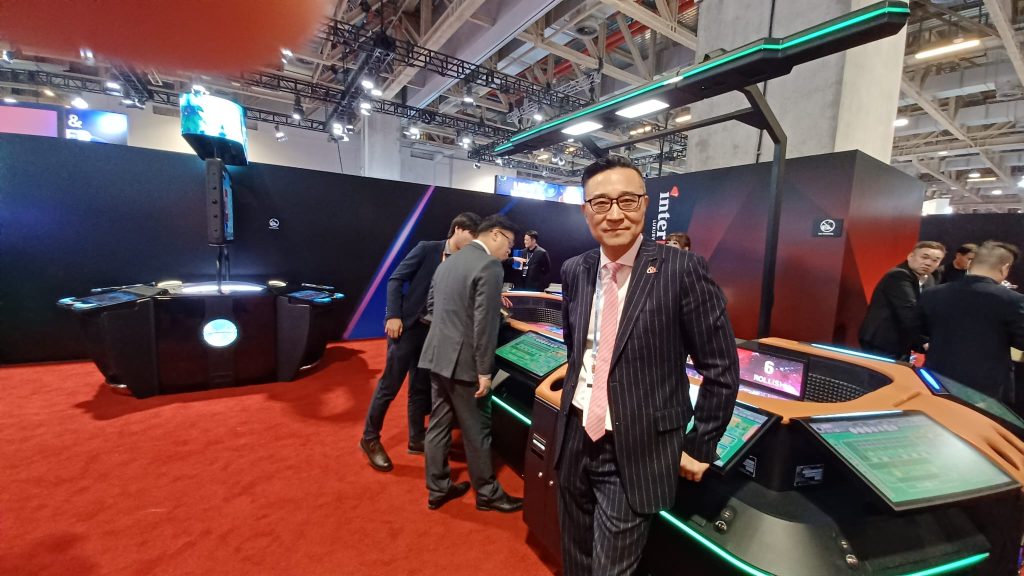
AMUSE’s Free Fall Roulette (pictured above next to Mr Hu), is offered via Interblock’s Universal Cabinet (UC) and described as a “pinball-style twist” on roulette. The play mechanism is inspired by Plinko ball drop, according to Interblock’s corporate materials.
Free Fall Roulette is expected to go live in Asia within the current quarter, Mr Hu told GGRAsia, saying Macau and the Philippines were target markets.
Free Fall Roulette’s appeal lies in its mechanical-style presentation, as well as the “fast” pace of the game, Mr Hu stated.
“That means more games, more handle, more revenue generation” for the host casino operator that installs Free Fall Roulette, said the Interblock senior executive.
AMUSE’s Dragon Roulette (pictured below), is built on one of the assets Interblock acquired from Aruze Gaming America Inc, and will be promoted in Asia gaming markets this year, Mr Hu stated.

“The beauty of this game is that it is not a traditional roulette,” the Interblock executive noted.
Dragon Roulette is said to feature a bonus stage with multiple ball launches, where the player’s jackpots or payouts are determined based on into which “pocket” the ball will eventually roll.
Regulatory categorisation
Regulatory categorisation of Dragon Roulette varies across gaming jurisdictions in Asia, due to its hybrid style, said Mr Hu.
Singapore and the Philippines recognise Dragon Roulette as an ETG. Macau takes a separate approach.
“We are not going to have Dragon Roulette being approved as a roulette [in Macau],” as the gameplay and payouts are different from typical roulette game rules approved by the city’s Gaming Inspection and Coordination Bureau (DICJ), Mr Hu noted.
In Macau it will be “approved… as an EGM [electronic gaming machine]-like slot,” said Mr Hu.
The AMUSE range is intended for new-to-casino players seeking “fun” and entertainment distinctive from a traditional gaming experience, the Interblock executiveremarked.
“I think the advantage for Interblock is its focus on new games development. Every year, we have at least… three to four games new to the market,” stated Mr Hu.
Refreshing games
To refresh existing games “we need to add new features, new functionalities, and make them capable of making more money” for casino operators he noted.
Interblock plans this year for Asian markets, enhancements to the brand’s existing multi-game stadium gaming products. That is likely to encompass tournament formats, side bets and progressive jackpots, Mr Hu said.
Interblock is poised to benefit from the “still-expanding” ETG sector with its product portfolio, as casino operators are looking to save labour costs, while also seeking products with heightened game security, Mr Hu additionally noted.
Its live-dealer-assisted Roll to Win Craps electronic table (pictured below) is targeted for the Philippines and Macau markets, the executive observed.
The product encompasses traditional craps gameplay with the use of real dice and can be operated with a single dealer. It offers chip-free gaming, according to corporate materials.
The product’s dice recognition system (DRS) is said to use a combination of advanced imaging, camera technology and radio frequency identification (RFID) technology designed to detect automatically and accurately, dice results.
Per Mr Hu’s explanation, a traditional live-dealer craps gaming table normally require three dealers per shift. That would mean daily, “10 to 12 people” per table, including pit supervisors. The main advantage of Roll to Win Craps is its ability to save on staffing, Mr Hu said.
Another plus is that with Roll to Win Craps – relative to the traditional format, there should be “no cheating, no fraud; the gaming management is made more transparent, and easier,” the Interblock executive told GGRAsia.